Cult of Flame
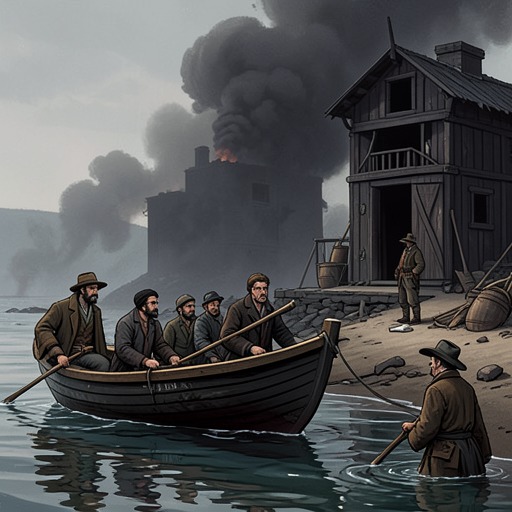
Chasing SunlightThe Cult of Flame is a southern religious organization whose theology and material practices challenge the authority of the Illuminated King and the Inquisition. Its members worship a fiery god, employ fire dust, and possess a familiarity with dangerous incendiary substances that makes them both useful and suspect. The narrative presents the Cult through the uneasy overlap of religion, technology, and forbidden knowledge: it is officially heretical, yet its expertise becomes necessary when the Endeavor encounters a damaged Cult vessel far from the movement's usual territory.
Religious Identity and Forbidden Practice
The Cult of Flame is associated with a theology that treats fire as more than an ordinary physical force. Its heretics would have mocked the overtly symbolic tapestry of an altar in flames, while the objects Jonathan Heights finds nearby include black stone casks and amphoras associated with fire dust and unflame. Fire dust is described as capable of burning with exceptional heat, whereas unflame represents the opposing extreme, something that burns cold. The Cult's religious identity is therefore bound to materials that are simultaneously weapons, substances of ritual significance, and threats to the established order.
The movement's practices are unacceptable within Beacon. Eleanor McAvey has never seen unflame used in action because the Illuminated King does not look kindly on its use there, and Jonathan Heights notes that the Inquisition is not gentle when boundaries are crossed. The distinction matters: occult heresy may be tolerated when nobles play at it without exposing the foundations of their power, but the handling of forbidden substances by an actual religious movement threatens the state's monopoly over what may be known, touched, and deployed.
The Cult's danger also lies in its resemblance to humanity. Antomine warns that what is closest to the familiar can be more tempting than what is completely alien. In his view, the Cult serves a god with interests of its own while cloaking that allegiance in a recognizable human form. This makes the organization a religious danger rather than merely a military one: its language, bodies, and practical competence can allow its ideas to cross boundaries that visibly monstrous beings cannot.
Position Within the World Order
The Cult of Flame operates in the south, particularly in connection with Godforge, where its heretics perform rituals atop the great lavafall. Its territory lies beyond the secure center of the Illuminated King's realm, and the organization is named alongside other threats that may intrude into human lands. Even within settled territory, the navy patrols against incursions from the Cult of Flame and Invidus Croft, though those patrols are directed more toward detecting penetration than protecting every settlement from the monstrous life beyond the walls.
The Cult thus occupies an ambiguous position in the geography of civilization. At Danby's Point, human settlements meet strange and savage peoples through trade that the authorities attempt to contain. The Cult is different from those eastern nonhuman societies because it shares humanity's general form and some of its institutions, but the state's hostility toward it shows that the boundary of acceptable humanity is ideological as well as biological. Antomine's declaration that the Illuminated King has no interest in adopting what dwells in the dark contrasts with the Cult's ability to use forces that the western regime fears but cannot simply eliminate.
Jonathan Heights's expedition also reveals the practical limits of official condemnation. His preparations include acquiring combustible supplies through discreet channels and arranging for them to be shipped east, because there is no time to travel to Godforge for the materials directly. The Cult is formally forbidden, yet its products circulate through smuggling networks and become part of the logistical infrastructure of exploration. The organization is therefore excluded from the official order while remaining entangled with that order's survival.
The Stranded Cult Vessel
The Cult becomes a direct presence in the expedition when the Endeavor spots an older airship bearing Cult insignia in the Sargasso. The vessel is built from myceliplank with a treated-canvas envelope rather than the Endeavor's sleek metal construction. Its envelope is badly damaged, yet the craft remains buoyant by tethering itself beneath a floating alien wreck, with ropes running down to a strange wooden skeletal structure whose machinery has disappeared. The people aboard wave frantically from its tilted railings, making their distress unmistakable.
The ship's appearance places the Cult outside its normal operating region. Jonathan Heights observes that the vessel is far from where the Cult usually operates, while the Sargasso's peculiar properties make its origin uncertain. Its painted red insignia appears in many places: some marks are faded by time, others newer, and together they give the vessel the impression of an aged but still functioning institution. The ship is not a symbolic apparition but a damaged cargo hauler carrying human beings whose religious affiliation has become an immediate obstacle to rescue.
Captain Montgomery argues that a good captain cannot leave airmen in distress, especially in such a dangerous place. Eleanor McAvey supports the rescue and points out that the Endeavor is already using fire dust to break through the mists; the Cult of Flame might handle the substance more safely and skillfully than the expedition can. Jonathan Heights agrees with the practical reasoning, in part because it undercuts Antomine's opposition, while Antomine insists that affiliation with the Cult is itself grounds for distrust.
Lieutenant Azhir and the Rescue Operation
The ranking officer aboard the stranded vessel is Lieutenant Azhir, a short, swarthy southerner whose rough, reddened skin reflects prolonged exposure to heat. Unlike many airmen, he bears brands rather than tattoos, including marks on his upper arm that record successful voyages. His appearance identifies him as a member of a distinct southern culture, but his military rank and command responsibilities also make him legible to the Endeavor's crew as a fellow airman.
Azhir explains that his captain was with the deacon when something came from Tor Ilek: dark fire. The deacon invoked the name of the Cult's fiery god, and the ship's people were protected, while those caught outside were reduced to scorched shadows. Azhir avoids speaking the god's name directly, a hesitation that reveals both reverence and danger. His account connects the Cult to the catastrophic forces associated with Tor Ilek and shows that its religious rites can operate as a form of protection, even when the result is horrifying to outsiders.
The two airships are joined by lines, and a rope bridge is strung between them while some of the Endeavor's crew remain at the guns in case the rescue becomes a deception. The Cult members do not attempt to seize the Endeavor. Antomine nevertheless orders continued vigilance, arguing that people who share human form may still act according to assumptions that are profoundly alien to western society. The rescue therefore becomes a test of whether common humanity, practical need, or religious difference should determine conduct.
Fire Dust, Cooperation, and Suspicion
Jonathan Heights eventually permits the Cult members to use the fire dust. Unlike residents of Beacon, they can touch it without immediate immolation or worse consequences, and the substance seems almost alive as it leaps from the cask toward their hands. Jonathan limits them to the smallest amount necessary for a single fragment of wood, distributing the material himself while Endeavor's crew frees pieces of the floating wreckage. The exchange converts the Cult's forbidden expertise into a concrete survival resource.
The cooperation does not dissolve the ideological conflict. Antomine argues that nothing done by the Cult can be trusted because its members share humanity's form while sharing little else. He accepts that desperate men may not deliberately sabotage their chance of escape, but warns that an action ordinary to them could be anathema to the Endeavor's crew. His concern is not limited to violence: their words may contain a hidden pattern capable of seducing or enlightening the unwary into perceiving fire as the southerners do.
Eleanor McAvey responds from an opposing moral position. She is angered that the stranded airmen are treated as more threatening than actual monsters and insists that helping people should matter when no monstrous force is visibly at work. Yet her own encounter with the rescued Cult members unsettles her. Watching the operation, she admits that she no longer sees people but things to harvest. The Cult's presence thus exposes a disturbing transformation in the rescuers themselves: the attempt to use its knowledge risks turning human allies into resources.
Conflict With the Illuminated King's Doctrine
The Cult of Flame stands opposite the Illuminated King's official doctrine of controlled illumination. Antomine, trained as a chaplain and skilled with zint weaponry, declares that humanity belongs to the light and that corrupting secrets must be purged. His commitment makes the Cult a particularly clear target, because its religion offers a competing account of what power is and how humans should relate to forces beyond the western walls.
When Antomine later confronts Ukari, he states that the Illuminated King has no interest in adopting the powers of the dark. The statement also defines the Cult by implication: fire and the southern god belong to the class of forces the regime refuses to incorporate, even when their practical value is obvious. At Bright Defile, Antomine's fear of Jonathan Heights mastering secrets beyond even the Illuminated King's comprehension reveals the same structure of thought. Knowledge becomes dangerous when it escapes authorized guardianship, whether it appears as sunlight, eastern secrets, or the Cult's fire.
The Cult therefore functions as both heresy and mirror. The Illuminated King's regime claims to protect humanity by erecting walls around darkness, while the Cult demonstrates that humans can enter into another kind of relationship with dangerous power. Neither position is presented as simple safety. The Cult's fire can preserve a ship and destroy people; the Inquisition's prohibition can restrain catastrophe but also convert difference into guilt before any action occurs.
Narrative Significance
The Cult of Flame gives the expedition a form of enemy that cannot be reduced to the monstrous. Its members are human airmen, organized under officers such as Lieutenant Azhir, yet their religion, vocabulary, and handling of fire dust make them threatening to the western characters. This combination complicates the world’s opposition between light and darkness: the most unsettling danger may be a familiar human community whose allegiance is directed elsewhere.
Its encounter with the Endeavor also makes the Cult part of the book's recurring economy of forbidden knowledge. Jonathan Heights's expedition depends on materials the state distrusts, while Antomine's mission depends on excluding precisely those materials and beliefs. The rescue succeeds because the characters temporarily treat expertise as more important than orthodoxy, but the suspicion surrounding the cooperation never disappears. The Cult of Flame remains a heresy, a potential ally, a source of specialized power, and evidence that civilization's boundaries are maintained through selective prohibition as much as through illumination.